China’s precision manufacturing sector is moving from scale-driven production toward measurable accuracy, automation, and resilient supply chains. So, what are the latest trends in precision manufacturing? The answer begins with industrial robotics, smart factories, and advanced materials. According to the International Federation of Robotics’ World Robotics 2024 report, China installed 276,288 industrial robots in 2023. This represented more than half of global installations. Its operational robot stock also exceeded 1.7 million units.
The shift is visible on factory floors. A machining center now records tool wear, vibration, temperature, and dimensional drift in real time. Artificial intelligence can identify abnormal cutting patterns before a finished component fails inspection. China’s Ministry of Industry and Information Technology has continued promoting intelligent manufacturing demonstration factories, covering automotive, electronics, medical equipment, and aerospace supply chains. These programs encourage digital twins, industrial internet platforms, and integrated quality control.
Materials matter, too. High-end bearings, semiconductor equipment, precision molds, and lightweight alloys require tighter tolerances and stronger process traceability. The World Intellectual Property Organization ranked China 11th in the Global Innovation Index 2024, reflecting sustained growth in patents, research capacity, and industrial technology. However, patent volume does not always equal production reliability. That distinction deserves attention.
Regional capability also remains uneven. Large manufacturers may deploy automated inspection systems, while smaller suppliers still depend on manual measurement and fragmented software. Energy use, cybersecurity, skilled-worker shortages, and costly equipment upgrades create practical barriers. Progress is real, but not perfectly balanced. The most credible outlook combines official statistics, independent industry research, and evidence from daily production performance.
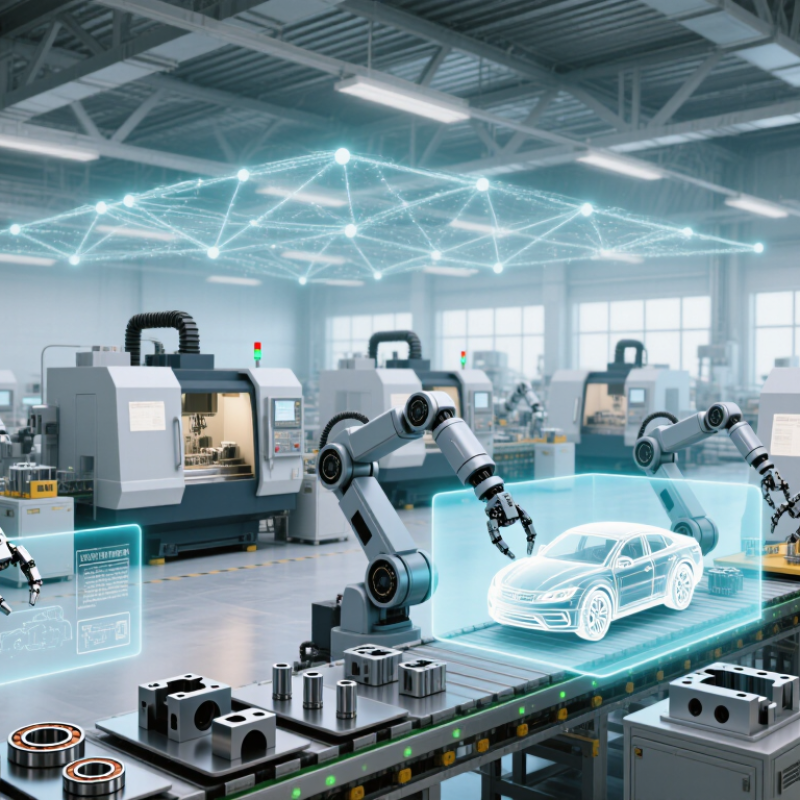
China’s precision manufacturing industry is expanding beyond conventional machining. It combines micron-level processing, advanced materials, digital control, inspection, and intelligent production systems. There is no single national statistical category for “precision manufacturing.” This creates measurement gaps.
Its practical scope includes high-end CNC equipment, precision molds, robotics, semiconductor tools, medical instruments, aerospace parts, and new-energy components. It also covers industrial software, sensors, metrology, and process engineering. The China Statistical Yearbook 2024 reported that high-tech manufacturing represented 15.7% of China’s above-scale industrial added value in 2023. Equipment manufacturing contributed 33.6%. These figures are broader than precision manufacturing, but they show its industrial foundation.
Automation is becoming central. The International Federation of Robotics reported 276,288 industrial robot installations in China during 2023, accounting for more than half of global installations. In a factory, this may mean robotic loading, inline vision checks, and traceable measurements after each machining cycle. Data is now part of the product. However, automation alone does not guarantee precision. Calibration quality, operator experience, material stability, and maintenance still decide results. The industry sometimes treats digital dashboards as proof of capability. That assumption needs more testing. The next trend is likely deeper integration among equipment, software, materials, and quality control, rather than faster machines alone.
| Dimension | Indicator or Scope | Latest Data | Period | Relevance to Precision Manufacturing | Source |
|---|---|---|---|---|---|
| Industry Definition | Manufacturing based on tight dimensional tolerances, repeatable processes, advanced materials, digital process control, and rigorous quality assurance. | A specialized activity within advanced manufacturing rather than a single official statistical industry classification. | Current scope | Includes precision machining, advanced tooling, micro-manufacturing, high-performance components, smart equipment, and inspection systems. | Classification synthesized from national advanced-manufacturing and industrial policy frameworks |
| Manufacturing Scale | Manufacturing value added | Approximately RMB 33.5 trillion | 2023 | Provides the economic base for precision components, equipment, materials, and industrial services. | National Bureau of Statistics of China |
| Manufacturing Contribution | Manufacturing share of national GDP | Approximately 26.2% | 2023 | Shows the strategic importance of manufacturing-related supply chains in the national economy. | National Bureau of Statistics of China |
| High-Tech Manufacturing | Growth of high-tech manufacturing value added | Increased by 8.9% year over year | 2024 | Reflects rising demand for advanced electronics, medical equipment, aerospace-related components, and intelligent production systems. | National Bureau of Statistics of China, 2024 industrial output data |
| Equipment Manufacturing | Growth of equipment manufacturing value added | Increased by 7.7% year over year; represented about 34.6% of industrial value added | 2024 | Indicates expansion in high-precision machinery, electrical equipment, automation systems, and specialized production assets. | National Bureau of Statistics of China |
| Industrial Automation | Industrial robot production | Approximately 556,000 sets; increased by 14.2% year over year | 2024 | Supports automated assembly, high-repeatability machining, material handling, and inspection operations. | National Bureau of Statistics of China |
| Digital Transformation | Use of industrial internet, sensors, machine vision, digital twins, and data-driven production control | Key national development direction; adoption measured through smart factories and digitally connected workshops | 2023–2025 trend | Improves traceability, process stability, predictive maintenance, yield, and production flexibility. | Ministry of Industry and Information Technology of China |
| Research and Development | National research and development expenditure intensity | 2.68% of GDP; total expenditure approximately RMB 3.61 trillion | 2024 | Supports advances in precision materials, manufacturing equipment, process software, metrology, and production engineering. | National Bureau of Statistics of China |
| Quality and Metrology | Core capabilities: coordinate measurement, machine vision, non-destructive testing, process monitoring, and statistical quality control | Increasingly integrated into production rather than performed only at final inspection | Current trend | Enables tighter tolerances, closed-loop manufacturing, lower scrap rates, and stronger product traceability. | National standards and industrial quality-management practices |
| Sustainability | Energy-efficient equipment, material utilization, process optimization, and carbon-aware production | Sustainability is increasingly incorporated into factory upgrades and equipment selection | 2023–2025 trend | Precision processes can reduce material waste, rework, energy consumption, and lifecycle costs. | China’s green manufacturing and carbon-reduction policy framework |
| Primary Application Areas | Automotive and new-energy equipment, electronics, medical devices, aerospace, optics, renewable-energy equipment, and industrial machinery | Broad cross-sector application | Current scope | These sectors require reliable high-precision parts, low defect rates, advanced materials, and documented process capability. | Industrial application categories reflected in national manufacturing strategies |
Note: Precision manufacturing is treated here as a cross-sector industrial category. The quantitative indicators are broader manufacturing or advanced-manufacturing statistics because China does not publish one unified national statistical series under the single label “precision manufacturing.”
It includes micron-level machining, advanced materials, digital controls, inspection, and intelligent production systems. Typical products include precision molds, robotics, medical instruments, aerospace parts, and energy components. It also covers sensors, metrology, industrial software, and process engineering.
Precision manufacturing has no single national statistical category. This creates measurement gaps. In 2023, high-tech manufacturing represented 15.7% of above-scale industrial added value. Equipment manufacturing contributed 33.6%. These figures are broader than precision manufacturing, but they show strong industrial support.
Robots can load parts, perform repetitive assembly, polish surfaces, and inspect components. Some lines record measurements after every machining cycle. That creates a digital trail. Automation helps, but it does not guarantee accurate parts. Calibration, maintenance, materials, and operator experience still matter.
Real-time sensors, automatic tool compensation, thermal control, and machine vision improve process stability. Vision systems can detect tiny surface defects within seconds. Coordinate measuring machines provide additional dimensional evidence. The strongest factories combine both methods. A dashboard alone proves very little.
Temperature changes can shift dimensions during long production runs. Worn tools may create uneven surfaces or incorrect sizes. Factories should track vibration, temperature, and tool condition. Small signals matter. Ignoring them can turn a 12-micrometre tolerance into a failed part.
Digital twins simulate cutting paths, material movement, and maintenance risks before physical changes occur. They may reduce trial runs and production interruptions. Their accuracy depends on clean, connected data. Some facilities still keep information in separate systems. That weakness is often underestimated.
No. Certification supports traceability, environmental control, and safer production. It cannot replace daily process discipline. Operators must record deviations and investigate root causes. A certificate is evidence of a system, not proof of every part. That distinction is easy to forget.
Smaller factories may lack skilled technicians, integrated software, and affordable measurement systems. They may also face higher compliance and maintenance costs. Practical standards could clarify data formats, measurement uncertainty, and cybersecurity duties. The picture is incomplete. Human judgment remains necessary when machines detect defects but cannot explain them.
China’s precision manufacturing industry focuses on producing highly accurate, reliable, and consistent components and systems for advanced industrial applications. Its scope covers precision machining, intelligent equipment, micro-scale production, advanced materials, quality inspection, and integrated digital management. Key technologies include computer-controlled processing, industrial robotics, additive manufacturing, machine vision, sensor networks, artificial intelligence, and real-time data analysis. Together, these tools improve accuracy, productivity, traceability, and product consistency.
When considering what are the latest trends in precision manufacturing, the main developments include smart factories, greener production, flexible manufacturing lines, and closer integration between design, production, and inspection. These capabilities support applications in electronics, medical equipment, aerospace, automotive systems, energy, and other high-tech sectors. At the same time, the industry must address high investment costs, technical talent shortages, supply-chain resilience, cybersecurity, and increasingly demanding quality standards. Future development will likely emphasize independent innovation, standardized processes, low-carbon operations, digital collaboration, and adaptable production systems.

 HYDRA CNC